Gaming has never been more popular, and the push for higher frame rates, better visuals, and smooth gameplay has made graphics cards the centerpiece of every PC build. But while flagship GPUs often dominate headlines, most gamers aren’t chasing $1,000 hardware. The real battleground is in the budget and midrange space — where the majority of players look for the best price-to-performance graphics cards that can comfortably handle modern games at 1080p and 1440p resolutions.
In 2025, the budget GPU market is both more competitive and more confusing than ever. Between AMD’s affordable Radeon offerings, NVIDIA’s mainstream GeForce cards, and Intel’s push into discrete graphics with its Arc B-series, gamers have more choice than they did even two years ago. But which cards actually deliver the smoothest experience for the least money? How much VRAM do you really need? And can budget GPUs stretch to 1440p without leaving you disappointed?
This guide dives deep into the current landscape, exploring the best budget GPUs for 1080p and 1440p gaming, while explaining trends, trade-offs, and the practical advice you need to make the smartest buying decision.
Understanding the Resolution Targets: 1080p vs 1440p
To appreciate what makes a GPU “good enough,” it’s essential to understand what you’re asking it to do.
At 1080p (1920×1080), you’re dealing with a resolution that has long been the industry standard. Even modest GPUs can comfortably push past 60 frames per second in most modern titles, and competitive games often reach 120 to 240 FPS with the right settings. This makes 1080p the sweet spot for gamers who prioritize performance and value.
At 1440p (2560×1440), however, the demand on the GPU increases significantly. That higher pixel count translates into much more work per frame. Suddenly, the line between “smooth gameplay” and “choppy frustration” comes down to the card’s raw power, VRAM capacity, and how efficiently it can leverage modern features like upscaling and frame generation.
Budget GPUs in 2025 are generally optimized for 1080p, but the best among them can stretch into 1440p territory — provided you’re comfortable with a mix of medium-to-high settings and occasional reliance on DLSS, FSR, or XeSS.
The Price-to-Performance Equation
The number one priority for budget GPU buyers is value. A graphics card doesn’t have to top benchmark charts; it simply has to give you the most frames for every dollar spent.
The Current Market
As of 2025, the market is shaped by three major forces:
- AMD Radeon RX 7000-series cards like the RX 7600, which offer excellent rasterization (traditional graphics performance) at competitive prices.
- NVIDIA GeForce RTX 40-series and new 50-series entries, particularly the RTX 4060, which remains popular among budget-conscious gamers.
- Intel Arc B5xx and B580 GPUs, which have surprised many with their strong performance-to-cost ratio, especially after significant driver improvements.
This competition has driven more aggressive pricing strategies. It’s no longer unusual to find cards with decent 1080p performance in the $200–$300 range, with some stretching up to $350 if they promise better 1440p capability.
The Value Tipping Point
When evaluating budget GPUs, the tipping point comes down to frame rates at 1440p and VRAM capacity. Cards under $300 often ship with 8GB of VRAM, which is fine for today’s 1080p games but begins to show strain in newer AAA releases at higher resolutions. Stretching to cards with 12GB or more can mean the difference between “playable now” and “frustrated in two years.”
VRAM, Longevity, and Why Memory Matters
Video memory (VRAM) is often overlooked until it becomes a problem. Today’s budget GPUs frequently ship with 8GB, which is enough for esports titles and lighter workloads at 1080p. But for demanding AAA games at 1440p high settings, textures and effects can quickly exceed that buffer.
In practical terms, here’s how VRAM affects your experience:
- 8GB VRAM: Sufficient for most games at 1080p and medium settings at 1440p, but prone to stutter or lower-quality textures in future AAA titles.
- 12GB VRAM: A safer bet for gamers who want to dabble in 1440p without constant compromises. It extends the useful life of a card by a year or two.
- 16GB VRAM (rare in budget class): Overkill for most budget buyers, but ensures long-term relevance as texture sizes keep increasing.
The industry trend is clear: as game engines evolve, 8GB is becoming the bare minimum, and 12GB is the new standard for futureproofing. If you’re building a system you want to last, prioritizing VRAM is as important as raw GPU performance.
Features That Transform Budget GPUs
Modern GPUs are more than just raw horsepower. A large part of their value comes from software features and ecosystem support.
Upscaling Technologies
- NVIDIA DLSS (Deep Learning Super Sampling): Uses AI to upscale lower-resolution images to higher resolutions with impressive visual quality. Paired with frame generation, it can double perceived frame rates.
- AMD FSR (FidelityFX Super Resolution): An open-source upscaler available on many titles, supported even on older GPUs. Quality has improved dramatically with FSR 3.
- Intel XeSS: Intel’s own solution, compatible across GPU brands, offering performance boosts without locking users to one ecosystem.
These technologies let budget GPUs punch above their weight. A card that struggles with native 1440p might deliver smooth, sharp gameplay with upscaling enabled.
Driver Ecosystem and Maturity
AMD and NVIDIA have long histories of stable driver support, while Intel’s Arc GPUs initially struggled with performance inconsistencies. However, steady driver updates have improved Intel’s Arc lineup significantly, making them far more reliable in 2025 than at launch.
Power and Efficiency
Budget GPUs often draw less power, making them ideal for systems with modest power supplies. NVIDIA’s Ada Lovelace architecture and AMD’s RDNA3 designs both emphasize efficiency, while Intel’s latest Arc cards are finding a balance between wattage and performance.
The Best Budget GPUs for 1080p Gaming
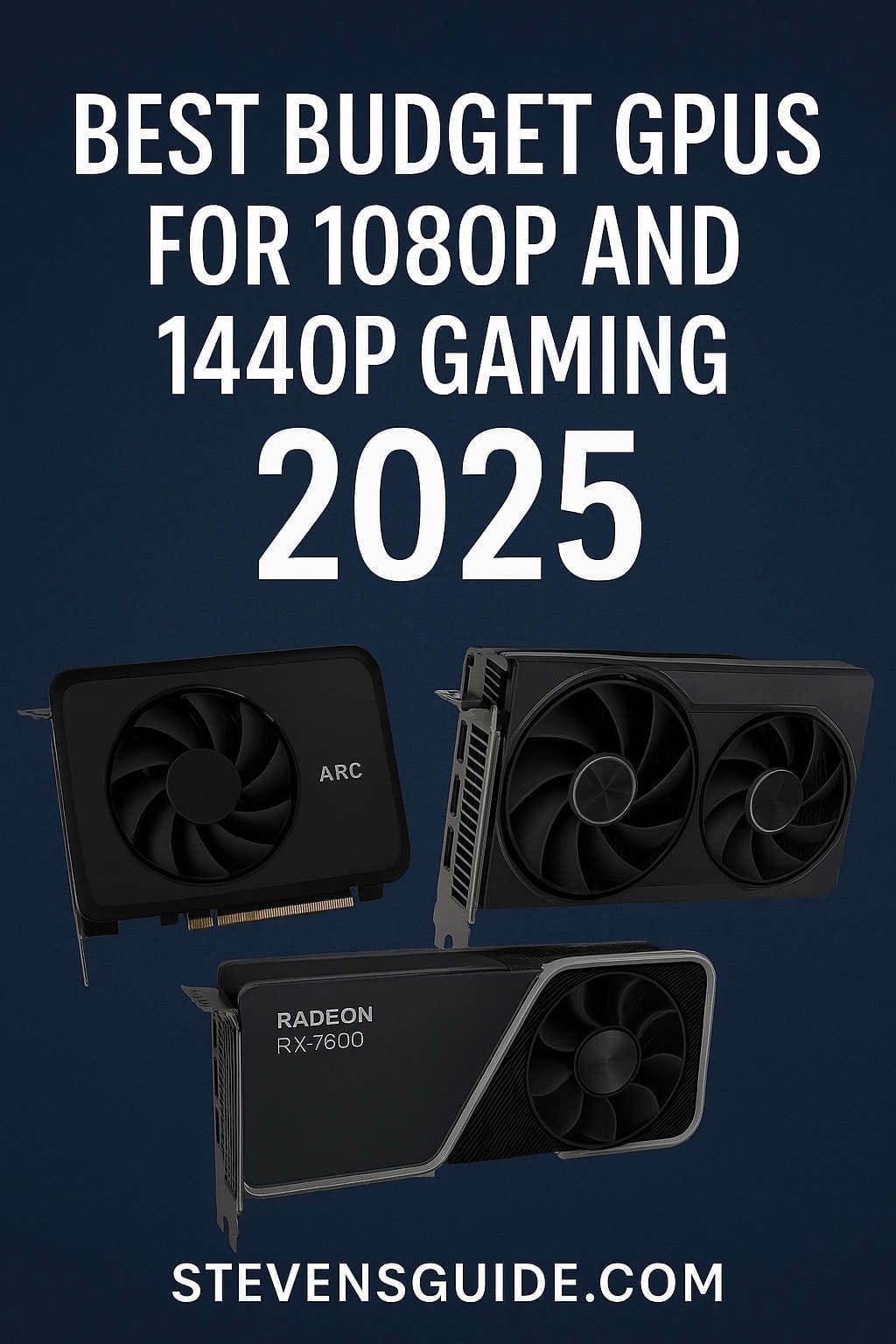
AMD Radeon RX 7600
The RX 7600 is AMD’s most approachable 7000-series card and shines at 1080p. It delivers high frame rates in esports titles like Valorant and CS2, while handling modern AAA games at high settings with ease. Its affordability makes it a strong recommendation for first-time builders.
NVIDIA GeForce RTX 4060
The RTX 4060 is a workhorse for budget-conscious players who want access to NVIDIA’s DLSS and frame generation features. While it may not always lead in raw rasterization, its ecosystem advantage often translates into smoother real-world performance.
Intel Arc B570
Intel’s Arc B570 is a pleasant surprise in the budget segment. With pricing that undercuts AMD and NVIDIA equivalents in many regions, and performance that consistently delivers 60+ FPS at 1080p, it has quickly become a favorite among gamers who want maximum frames per dollar.
The Best Budget GPUs for 1440p Gaming
AMD Radeon RX 6700 XT (Used Market)
Though not a new release, the RX 6700 XT is widely available on the second-hand market at attractive prices. Its 12GB of VRAM makes it a strong contender for budget-minded gamers who want a reliable 1440p experience.
NVIDIA RTX 3060 Ti (Used Market)
Another older but still relevant card, the RTX 3060 Ti remains a balanced choice for 1440p gaming. DLSS support extends its longevity, and it often trades blows with newer, more expensive cards.
Stretching Beyond Budget: RTX 4070 and RX 7700 XT
For gamers who want uncompromised 1440p performance but still want relative value, stretching the budget slightly opens the door to cards like the RTX 4070 or RX 7700 XT. While not strictly “budget,” they are often the most sensible upgrade path for serious 1440p players.
Buying Advice: How to Choose the Right GPU
When shopping for a budget GPU in 2025, focus on these priorities:
- Resolution Goal: Stick with cards optimized for 1080p if your monitor is Full HD. For 1440p, prioritize VRAM and stronger GPUs, even if it costs a bit more.
- VRAM Capacity: Aim for 12GB when possible, especially for 1440p gaming.
- Feature Set: Consider the ecosystem — DLSS, FSR, or XeSS can dramatically change your gaming experience.
- Price Tracking: Prices fluctuate weekly. Monitor sales, promotions, and consider the used market for extra value.
- Futureproofing: Spending slightly more today can save you from another upgrade in just a year or two.
Trends Shaping the Budget GPU Market
- Upscaling is becoming standard practice. Nearly every major game engine supports DLSS, FSR, or XeSS, making it possible for budget GPUs to remain viable longer.
- VRAM creep continues. Games are demanding more memory, pushing manufacturers to offer 12GB or more even on midrange cards.
- Intel’s rise in the GPU market. Once written off, Intel’s Arc lineup is now a serious alternative, applying pressure on AMD and NVIDIA in the budget space.
- Used GPUs are more attractive. As gamers upgrade, the second-hand market remains one of the best sources of affordable 1440p-capable cards.
Conclusion: The Smart Path Forward
The best budget GPU for 1080p and 1440p gaming in 2025 isn’t a one-size-fits-all answer. It depends on your resolution target, budget flexibility, and how much you care about futureproofing.
If you’re building a pure 1080p system, the AMD RX 7600, NVIDIA RTX 4060, and Intel Arc B570 stand out as excellent options. For gamers who want to push into 1440p territory, the RX 6700 XT and RTX 3060 Ti still deliver excellent value, while stretching toward an RTX 4070 or RX 7700 XT makes sense for longer-term investment.
Above all, remember this: buy for your monitor, not just your wallet. If you’re gaming on a 1080p display, a budget card will keep you happy for years. But if you’ve already invested in a 1440p monitor, consider pushing your budget slightly higher — the smoother, richer experience will be worth it.
You might also like,
- Best Gaming Headphones Under $150
- Best Budget PC Build Under $800 for Content Creators in 2025
- The Best Monitors for Photo Editing in 2025: A Complete Guide
- Best Budget Gaming PC Build Under $800 (2025) – Ultimate Parts List & Guide
- Tech You Should Skip When Building a Budget PC Setup (Save Money on Smarter Choices)